Why Pre-Empanelment Juror Background Investigations Matter
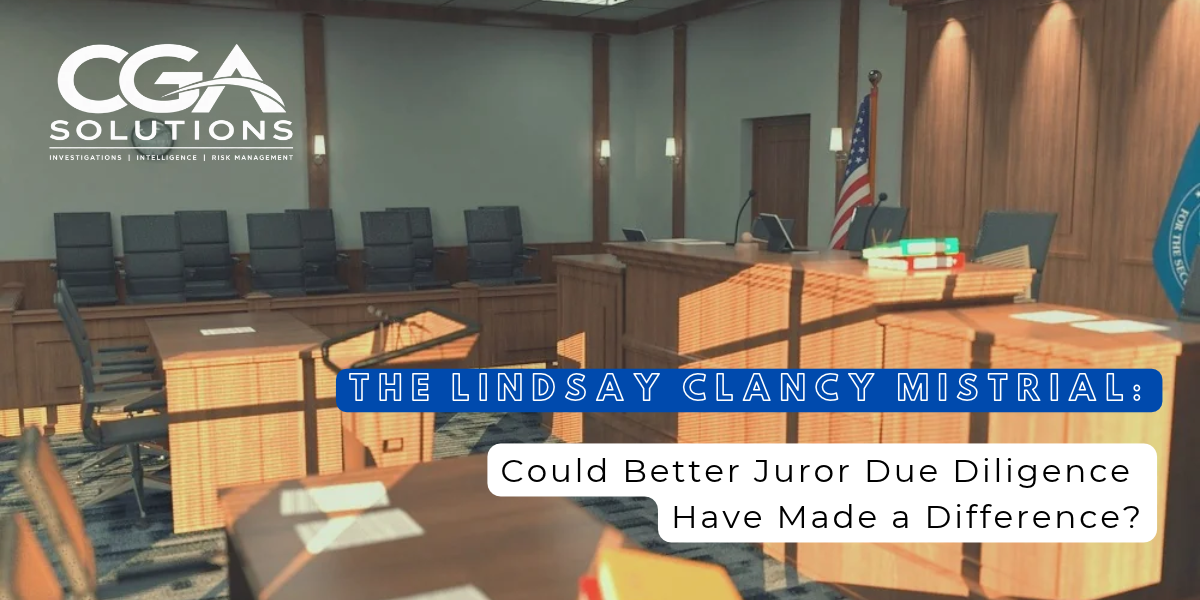
When Lindsay Clancy’s murder trial ended in a mistrial in September, 2026, the outcome hinged on a single juror. After seven days of deliberations, 11 jurors reportedly favored finding Clancy not criminally responsible for the deaths of her three young children, but a lone holdout juror prevented a unanimous verdict.
What followed was a controversy that should capture the attention of every criminal defense investigator.
Clancy’s defense team subsequently raised allegations concerning the holdout juror, Michael Desronvil, including claims that he had failed to disclose relevant legal history during jury selection. According to reporting, that history included a dismissed domestic violence charge and an active restraining order. The defense also alleged misconduct during deliberations.
These allegations have not been established as judicial findings. Nevertheless, they present an important question for the investigative profession:
Could a comprehensive background investigation of prospective jurors, conducted before empanelment, have prevented the mistrial?
We believe that an effective investigation could have identified potentially relevant discrepancies between the holdout juror’s questionnaire responses and publicly available facts, and therefore would have provided defense counsel with actionable information.
The Juror Questionnaire: An Investigative Starting Point
In Massachusetts, prospective jurors complete confidential questionnaires and provide personally identifying information and answers concerning their backgrounds, experiences, and potential conflicts.
For defense investigators working under counsel’s direction, these questionnaires are more than administrative documents. They provide the starting point for a targeted investigation designed to verify material disclosures and identify indicators of potential bias.
The investigator’s first responsibility is to determine whether the information supplied by each prospective juror is accurate, complete, and consistent with independently verifiable records.
This is particularly important when questionnaires address matters such as prior involvement in criminal or civil proceedings. In the Clancy case, the defense’s subsequent allegations concerning the holdout juror illustrate the significance of this verification process.
If a prospective juror answered a relevant question concerning previous legal proceedings in the negative, an investigator could have leveraged open-source intelligence (primarily Massachusetts court records) to determine whether the response was consistent with verifiable facts.
While a potential discrepancy would not establish intentional deception, it would provide defense counsel with a specific issue to address during voir dire.
That distinction is central to effective juror due diligence. Investigators identify and corroborate relevant facts; attorneys and judges determine their legal significance. As investigators, when it comes to voir dire, we owe our clients nothing less than a thorough and exhaustive due diligence investigation.
What a Defense Investigator Could Have Uncovered
A thorough juror background investigation begins with the identifying information lawfully available through the questionnaire and continues through several layers of verification.
Open-Source Intelligence: Criminal and Civil Court Records
A critical first step in the due diligence process is a search of publicly accessible court records in jurisdictions associated with a prospective juror. These searches may identify prior criminal proceedings, civil litigation, and possibly the issuance of protective orders.
Critically, a defense investigator must distinguish between an arrest, a criminal charge, a dismissal, and a conviction. These are not interchangeable findings.
Had accessible records concerning the Clancy holdout juror been identified before empanelment, the defense might have had an opportunity to compare those records against his questionnaire responses. If the information appeared inconsistent, counsel could have requested additional questioning to clarify the discrepancy.
That opportunity is substantially different from attempting to establish the significance of an alleged omission after a mistrial.
Address and Identity Verification
Public record research is only as reliable as the investigator’s ability to associate records with the correct individual.
Questionnaire information can be cross-referenced against closed-source intelligence to confirm address histories, property records, and other public data points to clarify identity and determine which jurisdictions warrant additional searches.
For investigators, this step is critical because false positive matches can be just as damaging as missed information. An inaccurate report attributing another person’s criminal history to a prospective juror could unfairly influence counsel’s decisions and undermine the integrity of the investigative process. It damages the defense to exclude unbiased, honest, and forthright potential jurors just as much as it damages it to include dishonest potential jurors. Every potentially significant finding should therefore be corroborated before being presented as fact.
Social Media Intelligence
Prospective jurors may have publicly expressed opinions that bear directly on their ability to evaluate a particular case impartially.
Clancy’s defense centered on postpartum psychosis and whether she was criminally responsible for her actions.
An investigator could have utilized social media intelligence tools and looked for statements concerning the Clancy case, the insanity defense, postpartum mental illness, or other strongly held beliefs about criminal responsibility.
A prospective juror who publicly declared that mental illness should never excuse homicide, for example, might warrant additional inquiry during voir dire about the ability to follow the court’s instructions.
Similarly, a juror who had previously posted an unequivocal opinion about Clancy’s guilt could raise legitimate questions concerning preconceived bias.
Such findings would not automatically disqualify the prospective juror. But failing to investigate these avenues and thereby failing to present these findings to defense counsel could harm the defense case overall.
Turning Investigative Findings Into Actionable Intelligence
The usefulness of juror due diligence depends as much on the quality of the reporting as on the underlying research.
Defense attorneys conducting jury selection frequently have limited time to evaluate prospective jurors. A lengthy investigative report containing unverified information, irrelevant personal details, or speculative conclusions can become a liability rather than an asset.
A more useful deliverable is a concise, source-supported investigative summary organized around material findings.
We recommend the following hypothetical example. (Note: this is not an actual finding concerning any Clancy juror.)
| Juror Due Diligence Report | |
| Juror identifier: | Juror No. 14 |
| Questionnaire response: | No prior involvement in criminal proceedings reported |
| Investigative finding: | Potentially matching dismissed criminal proceeding identified in public court records |
| Verification status: | Identity match and precise questionnaire language confirmed through multiple closed-source intelligence sources |
| Recommended action: | Refer to counsel for review and, if appropriate, court-approved follow-up questioning |
This reporting approach provides counsel with a documented basis for deciding whether further inquiry is warranted during voir dire.
It also distinguishes verified evidence from preliminary leads, an essential practice when evaluating information that could affect an individual’s eligibility to serve on a jury.
An investigator should flag material concerns, preserve the supporting source records, and explain any limitations impacting those records’ reliability. The report should not label a prospective juror as dishonest, biased, or unfit merely because a potentially relevant record exists. Our role as investigators is to provide counsel with a complete set of facts; counsel’s role is to determine what should be done with those facts.
The Investigative Opportunity in the Clancy Case
The allegations raised after the Clancy mistrial provide an instructive example of how the timing of juror research can matter.
According to news reports, the defense questioned whether the holdout juror had accurately disclosed his legal history during jury selection. The defense subsequently sought judicial intervention based in part on those allegations. On November 9, 2026, Judge William Sullivan denied the defense’s motion to dismiss the charges and related requests for a juror inquiry.
Consider the alternative scenario.
If an investigator had received the prospective juror’s completed questionnaire before empanelment and had been able to identify court records involving that individual, verify the identity match, and determine that the record potentially contradicted a specific questionnaire response, defense counsel would have possessed potentially actionable information before the juror was seated.
Counsel could then have requested clarification through voir dire.
Depending on the explanation and the court’s assessment, the information might have supported a challenge for cause or informed the defense’s lawful use of a peremptory challenge.
The practical lesson here is unmistakable: information identified before empanelment can be evaluated within the jury selection process, rather than becoming the subject of difficult post-trial litigation.
What Juror Due Diligence Can—and Cannot—Accomplish
Even the most thorough background investigation cannot guarantee that a jury will reach a unanimous verdict. No investigator can predict precisely how an individual will evaluate testimony, interpret evidence, or respond to disagreements during deliberations.
Nor should investigative research be designed simply to eliminate prospective jurors whose personal beliefs might make them less receptive to a defense theory.
The legitimate objective is to uncover reliable information bearing on a juror’s ability and willingness to decide the case fairly and in accordance with the law.
That requires recognizing the difference between an unfavorable juror and an unsuitable juror.
A prospective juror who is skeptical of an insanity defense may nevertheless be capable of considering the evidence impartially. Conversely, an individual who expresses no obvious bias during voir dire may have made public statements directly contradicting that professed impartiality.
Independent due diligence can help counsel identify and explore those distinctions.
It can also expose material inconsistencies between questionnaire responses and public records before they affect the proceedings.
A Professional Standard for Defense Investigators
The Clancy prosecution demonstrates why juror due diligence should be treated as a substantive investigative assignment rather than an optional internet search.
A responsible investigation requires a repeatable methodology: reviewing the questionnaire, verifying identity, searching relevant public records, examining permissible online sources, corroborating material findings, and promptly reporting actionable information to counsel.
The investigation must also respect statutory confidentiality requirements, court orders, juror privacy, and ethical restrictions on juror contact.
Massachusetts General Laws Chapter 234A, Sections 22 and 23 govern juror questionnaires and their confidentiality. Massachusetts Rule of Professional Conduct 3.5 and ABA Formal Opinion 466 provide additional guidance concerning communications with jurors and research into their online presence.
For investigators, careful compliance with these requirements is part of the assignment, not an obstacle to it.
Conclusion: Investigate Before the Jury Is Seated
Whether the allegations regarding the holdout juror in Clancy’s mistrial ultimately establish misconduct is a matter for the courts, but they illustrate a risk that thorough, timely juror due diligence is specifically designed to address and mitigate.
When investigators are provided with prospective juror questionnaires, they have an opportunity to:
- Conduct focused background research
- Verify material disclosures
- Identify documented inconsistencies, and
- Provide counsel with information that might otherwise remain undiscovered.
That work does not guarantee a favorable verdict, nor does it entitle either party to a jury predisposed to its position. It does, however, help ensure that decisions about who serves on a jury are made with the most accurate, relevant, and reliable information reasonably available.
In a high-stakes criminal prosecution, that can make a meaningful difference not necessarily in the outcome of the case, but in the fairness and integrity of the process used to reach it.
Sources and References
Case reporting:
- Associated Press, November 9, 2026 — Judge denies motion to dismiss Lindsay Clancy murder charges
- Boston.com, November 9, 2026 — Clancy’s motion to dismiss denied
- Associated Press, October 2026 — Defense seeks inquiry into holdout juror
Investigative and legal authorities:
- Massachusetts General Laws, Chapter 234A, Section 22 — Juror questionnaires
- Massachusetts General Laws, Chapter 234A, Section 23 — Questionnaire confidentiality
- Massachusetts Superior Court Rule 6 — Jury Selection
- Massachusetts Rule of Professional Conduct 3.5
- American Bar Association Formal Opinion 466 — Lawyer Reviewing Jurors’ Internet Presence (2014)
This article examines potential investigative practices using publicly reported allegations. It does not assert that any juror acted improperly, that the defense failed to conduct adequate background research, or that additional investigation would necessarily have changed the outcome of the Clancy trial.