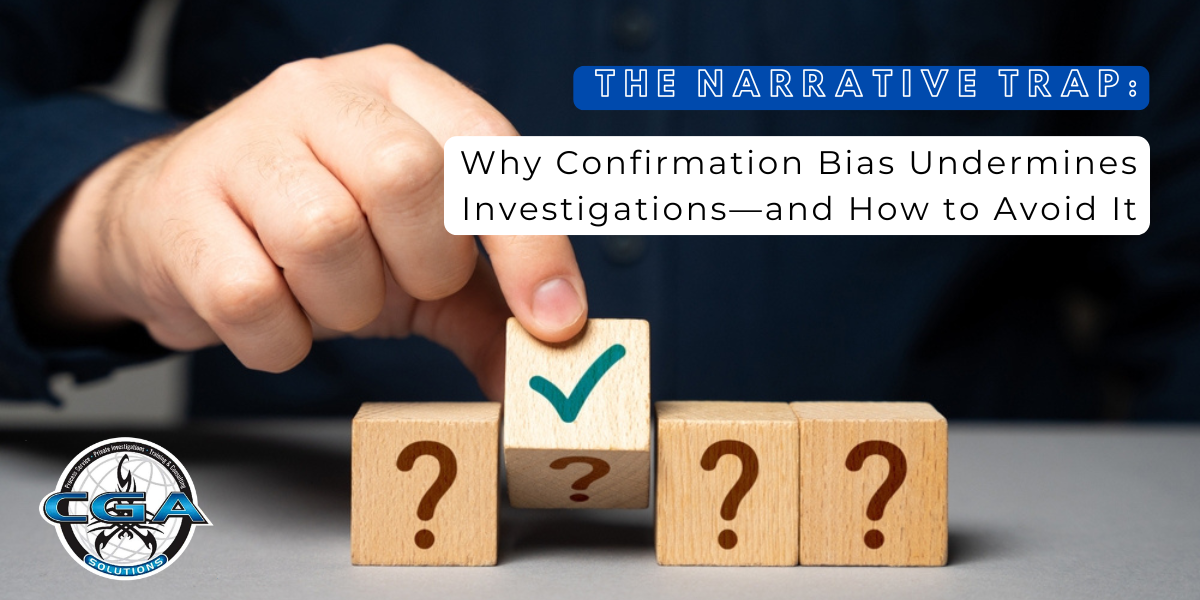
In the world of private investigations, facts are currency. Whether the assignment involves an insurance claim, civil litigation, or a corporate inquiry, clients depend on investigators to deliver something precise, defensible, and above all—accurate. But there is a persistent threat to that accuracy that rarely announces itself and often goes unnoticed until it’s too late: confirmation bias.
Among experienced investigators, it’s often referred to more bluntly as the narrative trap.
It doesn’t stem from incompetence or misconduct. In fact, it frequently arises in otherwise competent investigations. The problem is more fundamental—it’s cognitive. And when left unchecked, it can quietly distort the entire investigative process.
How the Narrative Trap Begins
Every investigation starts somewhere. A claims adjuster suspects fraud. An attorney outlines a theory of liability. A corporate client believes misconduct has occurred. These initial narratives are not only common—they are necessary. They provide direction and context.
But they are not evidence.
The narrative trap begins when that initial context evolves into an assumed conclusion, rather than a hypothesis to be tested. From that point forward, the investigation can begin to narrow, often without the investigator realizing it.
Instead of asking, “What happened?”, the process subtly shifts toward, “How do I prove what I’ve been told?”
That shift changes everything.
What Confirmation Bias Looks Like in the Field
Confirmation bias rarely appears as an obvious or ill-intentioned flaw. Instead, it manifests in small, cumulative decisions that shape the trajectory of an investigation. An investigator may schedule surveillance at times when activity is most likely, rather than across a representative range of conditions. Interviews may become more structured, steering toward answers that align with expectations. Database searches may focus on leads that reinforce the working theory while alternative avenues are left unexplored.
Even interpretation becomes affected. Ambiguous behavior—something that could reasonably be explained in multiple ways—gets framed in a manner consistent with the narrative. Over time, the investigation becomes less about discovery and more about validation.
By the time the final report is written, the findings often appear cohesive and persuasive. But beneath that surface, critical gaps may exist—gaps that can become highly visible under scrutiny.
The Cost of Getting It Wrong
For clients, the consequences of a biased investigation are not theoretical. They are practical, measurable, and sometimes impactful.
In insurance matters, a narrative-driven investigation can lead to incorrect claim determinations—either denying valid claims or validating fraudulent ones. In litigation, it can weaken a case when opposing counsel exposes inconsistencies or omissions. In corporate settings, it can result in flawed internal decisions that carry legal or reputational consequences.
Perhaps most significantly, biased investigations tend to collapse under pressure. When subjected to deposition or cross-examination, selective documentation and unsupported conclusions become difficult to defend. What initially appeared to be a strong, clear narrative can quickly unravel.
Clients don’t need investigators to confirm what they suspect. They need investigators to test whether those suspicions hold up.
A Familiar Scenario
Let’s consider a common assignment in the insurance context.
A claimant reports significant physical limitations following an injury. The adjuster suspects exaggeration and retains an investigator. That suspicion becomes the working narrative.
Surveillance is conducted over a limited number of days, often during periods when activity is most likely. The investigator captures footage showing the claimant performing tasks that appear inconsistent with reported limitations—lifting, bending, or engaging in routine activities.
The report emphasizes these moments. It is clean, structured, and seemingly compelling.
But what’s missing?
There may be no documentation of days when the claimant remained inactive. No effort to establish a baseline of behavior. No exploration of whether the observed activity is consistent with fluctuating medical conditions. No context.
If challenged, the report may still hold some value—but its credibility is diminished. Not because the observations were inaccurate, but because the investigation itself was incomplete.
Breaking Out of the Confirmation Bias Trap
Avoiding confirmation bias requires more than awareness. It requires structure. One of the most effective methods is the use of a competing hypothesis framework—a disciplined approach that forces the investigator to consider multiple explanations from the outset.
Instead of working from a single narrative, the investigator defines several plausible scenarios.
In the scenario discussed above, those might include:
- The claimant is exaggerating limitations
- The claimant’s reported condition is accurate
- The claimant’s capabilities vary depending on factors such as treatment, pain levels, or environment
The investigation is then designed to test all of these possibilities—not just one.
What a Better Investigation Looks Like
When investigators apply a competing hypothesis approach, the process changes in meaningful ways.
Surveillance is conducted across varied days and conditions, not just when activity is anticipated. Interviews are open-ended rather than leading. Observations include both activity and inactivity, providing a more complete picture of behavior over time.
Perhaps most importantly, the investigator actively looks for information that contradicts each hypothesis. This is a critical distinction. Evidence that challenges a theory is often more valuable than evidence that supports it, because it helps eliminate incorrect conclusions.
By the end of the process, the findings may still support the original suspicion—but if they do, that conclusion is now grounded in a balanced and defensible methodology.
The Difference Shows in the Report
You can often identify the quality of an investigation by reading the report.
Narrative-driven reports tend to feel persuasive. They move smoothly from point to point, building toward a conclusion. But they may lack balance, omit contradictory details, or rely on subtle interpretation.
In contrast, hypothesis-driven reports are more disciplined. They focus on what was observed, not what it means. They include details that both support and challenge potential conclusions. They avoid speculation.
They may be less dramatic—but they are far more reliable. And in a legal or claims environment, reliability carries more weight than persuasion.
What Clients Should Expect
For clients engaging investigative services, understanding this distinction is critical.
A high-quality investigation should:
- Document the full scope of observed behavior, not just selected moments
- Use neutral, descriptive language
- Provide clear timelines and context
- Demonstrate a consistent methodology
- Avoid drawing conclusions that go beyond the evidence
Equally important, clients should be mindful of how they frame assignments. When instructions are presented as conclusions—“We believe this individual is committing fraud”—they can unintentionally encourage confirmation bias.
A better approach is to request: “Objective documentation and analysis of the subject’s activities and condition.”
That subtle shift reinforces the investigator’s role as a fact finder, not an advocate.
Maintaining a Professional Standard in Private Investigations
At its core, the issue of confirmation bias is not just methodological—it’s professional.
Investigators operate in environments where their work may influence financial decisions, legal outcomes, and reputations. In many cases, their findings will be scrutinized by opposing counsel, judges, or regulatory bodies.
Under those conditions, the standard is not simply whether an investigation appears convincing. The standard is whether it is complete, objective, and defensible.
That standard cannot be met when the investigation is driven by a single narrative.
Conclusion
Confirmation bias is not an abstract concept—it is a practical risk that affects real investigations every day. Left unchecked, it can distort findings, weaken cases, and expose clients to unnecessary risk.
The solution is not to eliminate hypotheses, but to expand them. By adopting a competing hypothesis framework, investigators can move beyond the narrative trap and produce work that is more balanced, more rigorous, and ultimately more valuable.
In a profession built on facts, the goal is not to confirm what is suspected. It is to determine what is true.
And that requires a process designed to challenge assumptions—not reinforce them.
About the Author:
J. Alexander Chilton, LPI is a licensed private investigator in Georgia and South Carolina specializing in fact-based investigations, litigation support, and strategic security consulting. CGA Solutions provides objective, defensible investigative services to insurance carriers, attorneys and business/corporate clients.