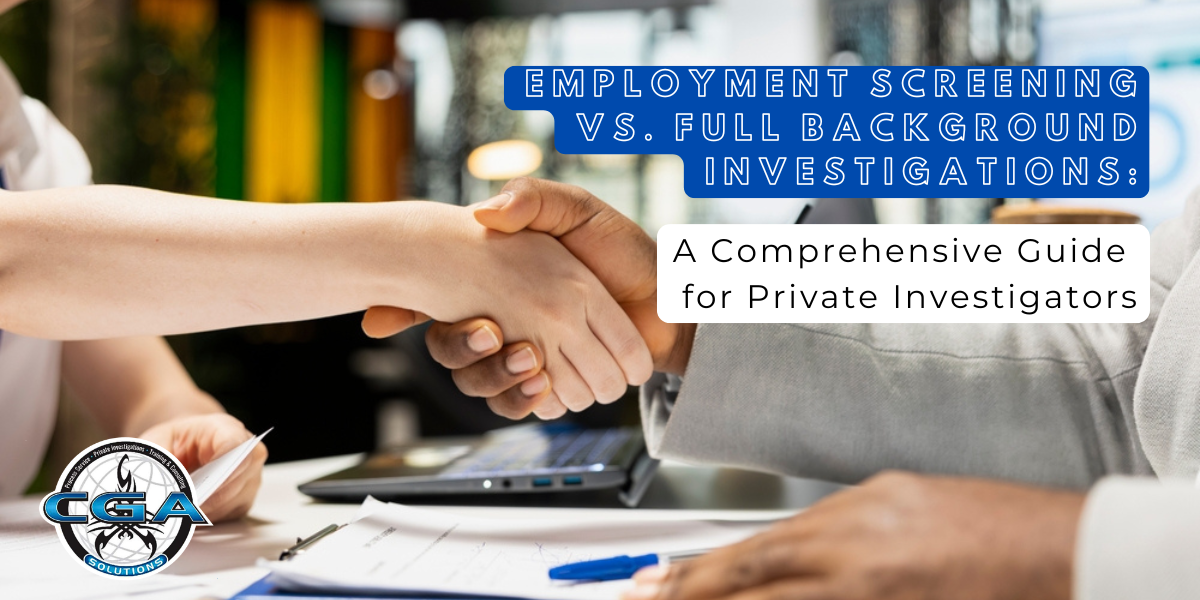
In today’s risk-conscious environment, private investigators are increasingly asked to conduct “background checks” for both corporate and private clients. Yet, a persistent and often dangerous misunderstanding remains: most clients do not distinguish between a legally regulated employment screening and a traditional investigative background investigation. This confusion creates significant exposure—not only for the client, but for the investigator as well.
From violations of the Fair Credit Reporting Act (FCRA) to improper reliance on consumer data and incomplete reporting, the legal pitfalls are substantial. For licensed investigators, operating safely requires more than investigative skill—it demands a precise understanding of where their work intersects with federal law, state regulations and evolving industry standards.
Throughout the rest of this post, we will analyze the critical differences between employment screenings and full background investigations, the regulatory framework governing each, and the liability risks that arise when those distinctions are ignored.
Understanding Employment Screenings
Employment screenings are not investigative in nature. They are standardized, highly regulated processes governed primarily by the Fair Credit Reporting Act (FCRA). These screenings are typically conducted by Consumer Reporting Agencies (CRAs), not private investigators operating in their traditional capacity.
A standard employment screening generally includes verification-based components such as identity confirmation, criminal history checks, sex offender registry searches, employment and education verification, motor vehicle records, and, where permitted, credit history and drug testing. The defining characteristic of these reports is their uniformity and legal constraint.
For private investigators, the distinction becomes critical when their work product is used for employment purposes. The moment an investigator provides a report intended to inform hiring, promotion, or retention decisions, they may legally be considered a CRA under federal law. This classification carries substantial compliance obligations, including obtaining proper authorization, ensuring strict accuracy, issuing pre-adverse and adverse action notices, and maintaining a formal dispute resolution process.
Failure to meet these requirements is one of the most common—and costly—sources of litigation against investigators.
The Nature of Traditional Background Investigations
In contrast, a traditional background investigation is expansive, analytical, and inherently investigative. Its purpose is not merely to verify discrete data points, but to construct a comprehensive “pattern of life” that reflects an individual’s behavior, reputation, and risk profile over time.
These investigations routinely incorporate social media analysis, civil litigation history, open-source intelligence (OSINT), asset and business affiliations, and direct human-source inquiries such as neighbor or associate interviews. They may also include digital footprint analysis and behavioral pattern recognition—areas entirely outside the scope of FCRA-generated reports.
Importantly, these investigations are not governed by the FCRA unless they are explicitly used for employment decision-making. Instead, they are regulated through a combination of state licensing laws, privacy statutes, and common law tort principles such as defamation, negligence, and invasion of privacy.
This distinction allows investigators to provide deeper, more contextual intelligence—but also requires disciplined adherence to legal boundaries.
FCRA Compliance: A Critical Risk Area for Private Investigators
FCRA compliance represents one of the most significant areas of exposure for investigators, largely because violations are often unintentional. The statute imposes strict limitations on what may be reported and how that information is obtained, verified, and communicated.
Common errors include reporting expunged or sealed records, including outdated arrest information, or providing reports to employers without ensuring proper disclosure and authorization procedures have been followed. Another frequent issue arises when investigators blend consumer data with independently developed intelligence, creating hybrid reports that inadvertently trigger FCRA obligations.
When a report is used in an employment context, liability can escalate quickly. Investigators may face statutory damages, attorney’s fees, regulatory enforcement actions, and even class-action lawsuits. The risk is compounded by the fact that downstream use of the report by the client can retroactively implicate the investigator.
For this reason, clearly defining the intended use of any investigation at the outset is not merely best practice, it is essential risk management.
State Law Variability and Multi-Jurisdictional Compliance
Beyond federal law, investigators must navigate a fragmented landscape of state-specific regulations. These laws govern access to criminal records, impose reporting limitations, and define permissible uses of certain types of information.
For example, some states impose seven-year reporting restrictions on adverse information, while others have strict limitations on the use of criminal history in employment decisions. States like California, New York, and Illinois have developed particularly robust frameworks that significantly impact how background information may be collected and used.
For investigators working across jurisdictions, this creates a layered compliance challenge. A single report may need to satisfy the legal requirements of the subject’s state, the client’s state, and the jurisdiction where the underlying records originated. Failure to account for these overlapping obligations can expose both the investigator and the client to regulatory and civil liability.
Negligent Hiring and the Limits of Consumer Reports
From a liability standpoint, one of the most important concepts for both investigators and clients is negligent hiring. Courts increasingly recognize that reliance on a basic consumer report may not constitute reasonable due diligence—particularly in high-risk hiring scenarios.
Standard CRA reports often fail to capture critical risk indicators such as civil litigation history, restraining orders, online threats, financial misconduct patterns, or behavioral red flags observable through social media and community reputation. When an incident occurs, plaintiff attorneys frequently argue that the employer failed to conduct a sufficiently thorough background investigation.
This is where private investigators provide measurable value. By delivering comprehensive, context-rich intelligence and identifying patterns of behavior, investigators bridge the gap between raw data and actionable insight. Their work transforms fragmented information into a coherent risk assessment—something automated systems are not designed to achieve.
Liability Risks in Investigative Practice
While traditional investigations offer greater depth, they also carry their own set of legal risks. Investigators must exercise caution to avoid misreporting, over-reporting, or including unverified allegations in their findings.
Legal exposure may arise from defamation claims, negligence, malicious reporting, or unlawful investigative techniques such as pretexting or unauthorized surveillance. Additionally, performing work that effectively constitutes employment screening—without maintaining FCRA compliance infrastructure—can create significant federal liability.
Accuracy, verification, and clear documentation are therefore non-negotiable elements of professional investigative practice.
A Common Scenario: Investigating a Caregiver
A frequently encountered situation involves families seeking to independently vet caregivers or domestic workers—often after being assured by a staffing agency that the individual has been “fully screened.”
In most cases, a licensed private investigator can conduct a background investigation for personal safety purposes, provided the work does not cross into regulated employment screening. The distinction hinges on intent: if the investigation is used strictly for personal decision-making, it generally falls outside FCRA scope. However, if the findings are used to hire, fire, or formally evaluate the individual as an employee, FCRA obligations may be triggered.
To mitigate risk, investigators should clearly document the purpose, scope, and legal limitations of the engagement in writing before commencing work.
Why Full Investigations Provide Superior Insight
The fundamental advantage of a full background investigation lies in its ability to produce actionable intelligence rather than static data. By incorporating human verification, contextual analysis, and behavioral assessment, investigators can identify risks that would otherwise remain undetected in database-driven reports.
This includes uncovering patterns of misconduct, reconciling conflicting information, and providing the narrative context necessary for informed decision-making. In an era increasingly dominated by automated data aggregation, this level of insight represents a critical differentiator.
The Evolving Role of the Private Investigator
As reliance on automated consumer reporting continues to grow, the role of the licensed private investigator becomes more—not less—important. Investigators provide what databases cannot: accuracy, context, verification, and meaningful interpretation of human behavior.
However, with that value comes responsibility. Understanding the legal boundaries between employment screening and investigative work—particularly the implications of the FCRA—is essential for protecting both the investigator and the client.
In a landscape defined by legal complexity and increasing liability, the most effective investigators are those who combine technical expertise with rigorous compliance discipline.